

I first tasted Domaine Comte Georges de Vogüé in 2003 while staying with a sommelier friend in the Catskills. He had an actual wine cellar beneath his house, so naturally we ended up down there looking for something to drink with dinner.
He pulled out a bottle of Vogüé and asked me if it “looked good.”
I could tell from his face that the correct response was probably some version of astonishment. The problem was, I didn’t know the wine yet.
A few hours later, I did.
We made steaks that night and mashed anchovy into butter to spread across them. Somewhere between the steak, the anchovy butter, and that bottle of Vogüé, I had one of the great wine evenings of my life. No elaborate tasting room, no formal dinner, no great occasion. Just a house in the Catskills and a Burgundy I had never heard of completely rearranged my idea of how good Pinot Noir could be.
More than 20 years later, I still remember that meal. That tells you something about the wine. Here’s why Vogüé has stayed with me, what makes the Domaine so singular, and why Musigny sits at the center of it all.
The Bottle That Changed the Way I Thought About Burgundy
Domaine Comte Georges de Vogüé, pronounced roughly “Vogue-way,” is now one of my two favorite Domaines in all of Burgundy.
The other is Domaine de la Romanée-Conti.
The wines could hardly be mistaken for one another, and I don’t love them for the same reasons. But in my mind, neither has a close rival in Burgundy or anywhere else in the world. I believe Vogüé is that exceptional and that singular.
What makes it difficult to describe is the contradiction at the center of the wine.
There is tremendous concentration, but almost no sense of weight. The wines feel linear and perfectly balanced, never broad or lumbering, yet there is far more going on underneath than their elegance first suggests.
And the aromatics can be ridiculous.
That combination is what I keep coming back to. Plenty of wines are powerful. Plenty are delicate. Vogüé somehow manages to give you intensity without making a show of it.
I still can’t entirely explain how they do that, which after all these years is probably part of the appeal. But there are clues. François Millet spent decades working with completely destemmed fruit, keeping yields low, handling extraction carefully, and using new oak with a pretty light hand. None of it was especially showy. Then again, neither are the wines.
Vogüé Has Had Five Centuries to Get This Right
The Domaine itself has had plenty of time to figure things out.
Its history reaches back to the 15th century, making it one of Burgundy’s oldest estates. It remains in the hands of descendants of the original family, passed down through the maternal line over generations.
Even more remarkable is what the family managed to hold onto.
They lost their noble titles, survived the French Revolution and the Reign of Terror, and retained vineyard holdings that today account for approximately 70% of Musigny Grand Cru.
In Burgundy, that matters.
The vineyards are famously fragmented, sometimes down to tiny parcels divided among numerous owners. To control that much of Musigny is not simply impressive on paper. It gives Vogüé an unusually deep relationship with one of the greatest Pinot Noir sites in the world.
And when you taste the wines, that history does not feel abstract.
The Style of Vogüé I Came to Love
François Millet was the winemaker at Vogüé from 1985 until the change in winemaking that came after 2021.
That earlier period is particularly meaningful to me because it produced the style of Vogüé I first encountered and came to love.
The fruit was completely destemmed, with no whole-bunch fermentation. In the vineyards, the Domaine followed lutte raisonnée, a reasoned approach to farming. The vines were plowed and kept free of chemical fertilizers, herbs were planted between the rows to help control pests, and pruning was strict.
The wines were then raised in oak, generally with only 15-35% new wood.
None of this sounds especially flamboyant, and that is rather the point.
The winemaking never seemed interested in announcing itself. What came through was Chambolle, Musigny, perfume, structure, and that impossible combination of delicacy and concentration that had caught me off guard in the Catskills.
Beginning in 2021, the Domaine moved in a different direction, including a greater use of whole-cluster fermentation and other changes in production. I am very interested to see how those wines develop.
But when I think about Vogüé instinctively, my mind still goes to the classic style I first knew.
Musigny Is Where Everything Comes Together

The Domaine controls roughly 70% of the Grand Cru, an extraordinary position in Burgundy and one that has become inseparable from its identity.
For me, the great Vogüé Musignys take everything I love about the estate and turn the volume up without making the wine louder.
That distinction matters.
The concentration becomes deeper. The perfume becomes more complex. There is structure underneath, but the wine never seems to need muscle to prove itself. Even with age and intensity, there is a kind of line running through it that keeps everything precise.
It is Burgundy behaving exactly as you hope Burgundy might behave when you spend far too much time thinking about Burgundy.
The wines can also age beautifully, which is another reason older bottles have always fascinated me. With time, that combination of perfume, concentration, and restraint becomes something much harder to reduce to a tasting note.
At a certain point, you stop cataloging aromas and simply keep drinking.

What I Remember Before Everything Else
I have tasted Vogüé many times since that first bottle in 2003. I understand the vineyards better now. I know the history. I know what the bottles can cost, how scarce they can be, and why collectors chase particular vintages.
None of that is what I remember first.
I remember walking downstairs into my friend’s cellar without knowing what he was about to pull out.
I remember realizing from his expression that I was apparently supposed to recognize the bottle.
I remember the steaks and the anchovy butter.
And I remember tasting the wine and understanding, without much context at all, that this was something different.
There is an enormous amount of information surrounding Burgundy. Producers, vineyards, classifications, vintages, parcels, winemakers, élevage. All of it matters, and I spend a large part of my life thinking about it.
But every once in a while, a bottle gets there before the information does.
Vogüé did that for me.
Why Vogüé Still Gets Me Excited

Not necessarily because they are the most expensive wines you have tasted or the rarest. They become reference points because everything you taste afterward gets compared, consciously or otherwise, with what that bottle showed you was possible.
Vogüé became one of those wines for me in 2003.
That experience is also why I enjoy talking about bottles like these with customers at Community Wine & Spirits. You can explain the history, the vineyard, the winemaking, and why Musigny occupies the place it does in Burgundy.
All of that helps.
But ultimately, there is still the wine.
More than two decades after my first bottle, I can describe Vogüé with more knowledge than I could that night in the Catskills. I am not sure I can describe the feeling any better.
Maybe I don’t need to.
I still remember the dinner.
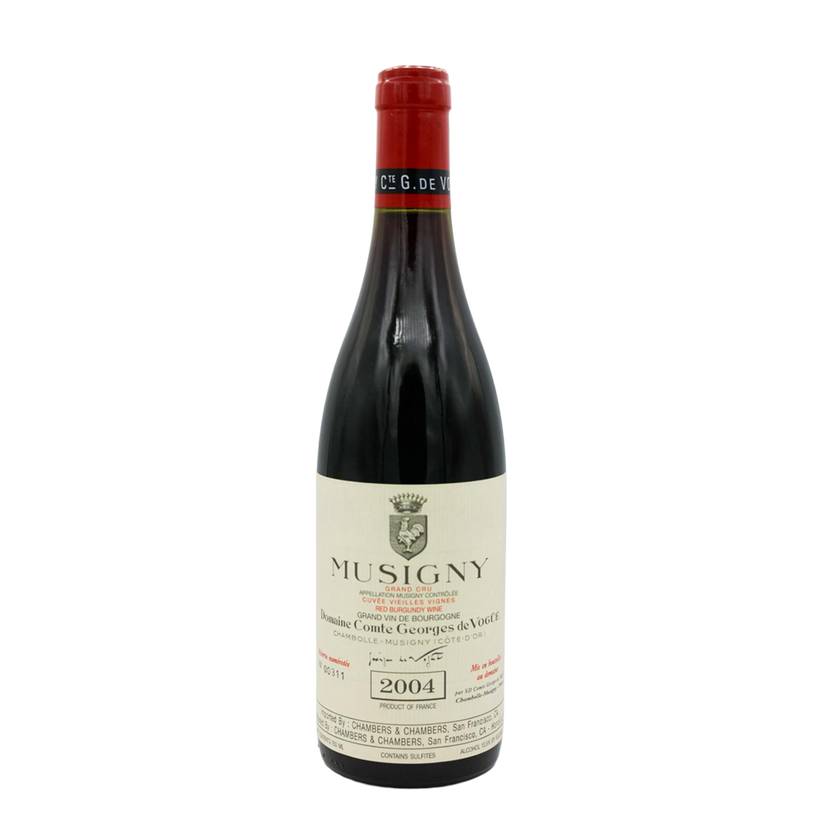
And that is why seeing a bottle like Vogüé Musigny Vieilles Vignes 2004 at Community still gets me excited. I know a great deal more about Vogüé now than I did in 2003, but some part of me is still in that cellar in the Catskills, about to find out what this wine can do.


